


$5.3M
Fresno bus accident settlement: a passenger tilted into a window on a curve when a safety lock the driver had not checked failed, causing a serious neck injury.
Personal Injury
Hurt on a bus without a crash? Wilshire Law Firm represents riders injured by sudden stops, falls while boarding or getting off, wheelchair securement failures and unsafe conditions on city, charter and private buses across California, with a free case review 24/7 and no fees unless you get paid. In 2025 we resolved a Los Angeles case for $2.3 million after a transit bus pulled away while our client was halfway aboard; past results do not guarantee a similar outcome.
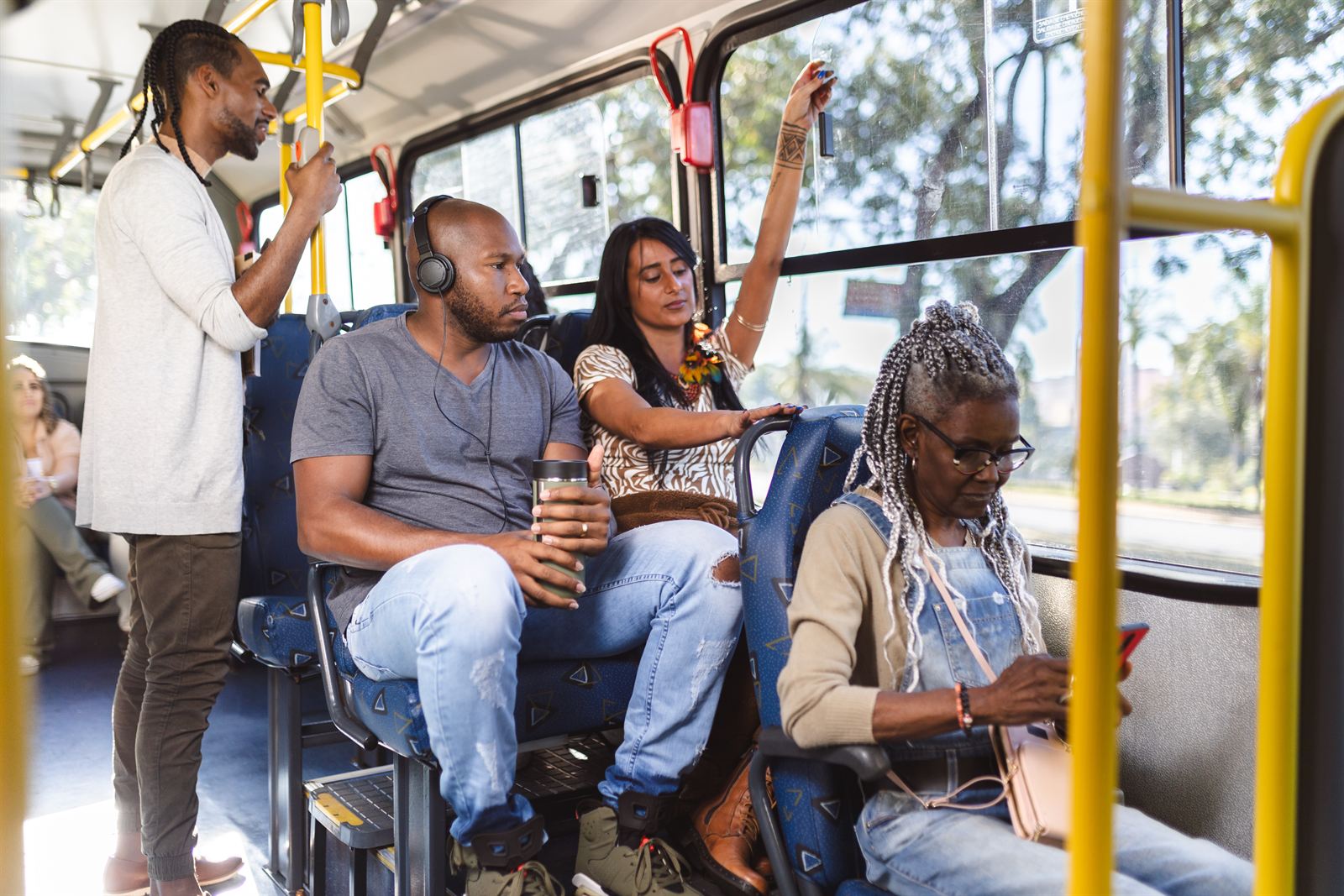
Explore essential resources on your rights, your options, and what to expect — everything you need to navigate the legal process, all in one place.
Passenger and boarding cases our team has resolved:
See more on our settlements and verdicts page. Past results do not guarantee a similar outcome. Every case is different.
Many passenger injuries happen without any collision: a rider standing in the aisle is thrown forward when the bus brakes hard, or falls when it lurches away from a stop. California law asks more of a bus operator than of an ordinary driver. The carrier owes riders the utmost care (Civ. Code § 2100) and must keep to a reasonable speed (§ 2104), and a driver who knows passengers are standing has to drive with that in mind.
A hard stop is not automatically negligence. If the operator braked to avoid a crash someone else caused, the other driver may be the one responsible. What decides these cases is the detail: how fast the bus was going, how closely it followed, whether the operator was distracted, and what the bus's own cameras and records show. Write down the route, the bus number, the time and the direction of travel while you still remember them.
The moments at the door are some of the riskiest. A carrier must give passengers "a reasonable degree of attention" (Civ. Code § 2103), which can include checking that riders are fully on or off before the doors close and the bus pulls away. Our $2.3 million Los Angeles result came from a bus that left while the passenger was still stepping aboard.
Other boarding injuries come from doors closing on a rider, a bus stopping too far from the curb, a step or handrail in poor repair, or an operator who pulls out before an older or disabled passenger has reached a seat or a handhold.
Federal rules for public and private bus operators require staff to use the vehicle's securement system for wheelchairs and, where necessary or on request, to help riders with securement, ramps and lifts, leaving their seats to do it if needed (49 CFR § 37.165(c), (f)). An operator may recommend that a rider transfer to a regular seat but may not require it (§ 37.165(e)).
When a chair tips because it was never strapped down, or a lift or ramp fails, both the operator's conduct and the equipment are at issue: a carrier must keep its buses safe and fit for their use (Civ. Code § 2101). Ramps can injure people outside the bus too: our $2.3 million Los Banos result came from a raised ramp that fell on a bystander.
A carrier must not overcrowd or overload its vehicle (Civ. Code § 2102), and the duty to keep the bus safe and fit covers seats, rails, latches, floors and windows (§ 2101). Our $5.3 million Fresno result followed a curve where a safety lock the driver had not checked gave way and a passenger tilted into a window.
Spills, debris and broken fixtures can also cause falls on board. If another rider attacked you, our public transportation accident page explains when the agency can answer for it.
Public buses. A city, county or transit agency can be liable for injuries caused by its employees acting within the scope of their jobs (Gov. Code § 815.2(a)). Before you can sue, you must present a written claim, usually within six months (Gov. Code § 911.2). Public agencies cannot be ordered to pay punitive damages (Gov. Code § 818). Our government claims guide walks through each step.
Charter, tour and private buses. No government claim is needed. In most cases the deadline to sue is two years from the injury (Code Civ. Proc. § 335.1).
Others who may share fault include a driver who cut off the bus, a company that maintained it, and the maker of a defective part.
Nationally Recognized Powerhouse, Fighting for the Justice You Deserve
Our award-winning attorneys have recovered billions for clients while taking on insurance companies and major corporations.
1 of 13
 Colin M. Jones, Esq.Senior Partner and Senior Trial Attorney, Chair of the Personal Injury Litigation Department
 Jennifer P. Burkes, Esq.Senior Partner & Strategic Advisor, Personal Injury Litigation Department
 Mary Lee Caruso, Esq.Senior Partner
 Ryan Casey, Esq.Senior Partner and Trial Attorney
 Tae-Yoon Kim, Esq.Senior Partner
 Mike Wellen, Esq.Partner
 Philip Andonian, Esq.Partner and Trial Attorney
 Alivia E. Abreu, Esq.Partner
 Shervin G. Ghanoongooi, Esq.Partner
 Christopher Goodroe, Esq.Partner
 Nathan A. Guest, Esq.Partner and Trial Attorney
 Brian M. Jacobson, Esq.Partner
 Ariella Perry, Esq.Partner
$5.3M
Fresno bus accident settlement: a passenger tilted into a window on a curve when a safety lock the driver had not checked failed, causing a serious neck injury.
$2.3M
Los Angeles bus accident settlement: a public transit bus pulled away as a passenger was halfway aboard. The passenger fell onto the concrete, causing back, hip and leg pain.
$2.3M
Los Banos bus accident settlement: a bus's lifted ramp fell and struck a bystander on the head, causing a traumatic brain injury, migraines, and neck and back pain.
*Past results do not guarantee similar outcomes. Each case is unique and evaluated on its own facts.
View more resultsWhat Should I Write Down After a Bus Injury?
Send it to someone who could use it, or copy it into ChatGPT, Gemini or your notes.


We'll contact you within minutes
No fees unless you get paid.
Record-breaking results
Our attorneys have recovered billions of dollars, including some of the biggest settlements in California.
17#1 Settlements in California, 2022–2024*
TopVerdict #1TopVerdict.com #1 settlements
1 of 17

#1 Truck v. Pedestrian Accident Settlement
2024

#1 Multi-Vehicle Accident Settlement
2024

#1 Equipment Malfunction Settlement
2024

#1 Car v. Stationary Object Collision Settlement
2024

#1 Bus v. Passenger Accident Settlement
2024

#1 Whistleblower Retaliation Settlement
2023

#1 Underinsured Motorist Settlement
2023

#1 Slip & Fall Accident Settlement
2023

#1 Negligent Security Settlement
2023

#1 Ladder Accident Settlement
2023

#1 Hotel Premises Liability Settlement
2023

#1 Car v. Car Collision Settlement
2023

#1 Bicycle Accident Settlement
2023

#1 Pregnancy Discrimination Settlement
2022

#1 Age/Disability Discrimination Settlement
2022

#1 Wrongful Termination Settlement
2022

#1 Meal & Rest Breaks Settlement
2022
*#1 settlements in California have been awarded by TopVerdict.com. Past results do not guarantee similar outcomes.
Our Most Frequently Asked Questions
We've answered the most common ones below. If yours isn't here, call us — we're available 24/7.
Tell the operator before you get off, so there is a record on the bus. Note the route, bus number, time and stop, take photos of where you fell, and get the names of witnesses. Keep your fare card or receipt as proof you were riding, and see a doctor the same day if you can. Then talk to us before video and records are lost or the claim deadline passes.
Standing doesn't rule out a claim. It's normal on a city bus, and the operator has to drive knowing that riders are on their feet.
Often, yes. Operators must use the securement system and help with it when needed or asked (49 CFR § 37.165(c), (f)), and a carrier owes riders the utmost care (Civ. Code § 2100). An injury from an unsecured chair, a failed lift or a ramp that gave way can support a claim against the operator, and against the maker if the equipment was defective.
Against a city or transit agency, a written claim within six months of the injury (Gov. Code § 911.2), then a lawsuit within six months of a written rejection (Gov. Code § 945.6). Against a private bus company, generally two years (Code Civ. Proc. § 335.1). If the six months have passed, see our government claims guide for the late-claim rules.
Nothing up front. Wilshire Law Firm handles bus injury cases on contingency, so there are no fees unless you get paid. Case reviews are free and available 24/7.
Locations
Find your nearest office — serving all of California and employment clients in Oregon and Washington.
Appointments required for office visitsCall 213-754-1375 to schedule